Back to Work

Scaling Candy Crush’s Content Engine

Designing AI-powered workflows and quality systems for a production pipeline serving 200M+ monthly players.

ROLEUX Designer
PLATFORMInternal Web Platform
TIMELINE2024–2025
TEAMPM, Level Designers, UX Design, Engineering, AI/ML, QA, Outsourced Studios
YEAR2025

Candy Crush Saga ships new levels every week to over 200 million players. With a back catalogue of 20,000+ levels as training data, King was investing in two parallel strategies to scale production: AI-assisted level generation and outsourced studio partnerships.

I joined King's tools team at this inflection point. The core platform already existed — Viper (a visual level editor), Level Manager (collections, A/B testing, releases), and Episode Planner (content scheduling). My role was designing the workflows, quality systems, and AI interaction models that would make the shift actually work.

The Shift

For most of its 12-year history, Candy Crush content was handcrafted by in-house level designers — experts who understood not just difficulty curves and game mechanics, but the intuitive feel of what makes a level fun.

That model was changing. The goal wasn't to replace senior designers — it was to redirect them toward higher-value creative work (new mechanics, game modes, experimental features) while AI and external teams handled the volume of standard content.

This is an organizational transformation, not just a tooling problem. And transformation creates friction at every seam.

AI collaboration

How do expert designers collaborate with AI output they didn't create?

Quality at scale

How do you maintain quality when production scales beyond your in-house team?

Tribal knowledge

How do you encode a decade of expertise so it transfers to machines and external studios?

Tool fragility

The pipeline was held together by spreadsheets, copy-pasting between tools, and manual processes with no automation.

Mapping the Production Pipeline

Before designing anything, I mapped the entire level production workflow end-to-end — every step from data curation through AI-driven and manual production tracks, live tweaking, playtesting, and release.

The maps revealed how fragile the system was. Data curation meant pulling from multiple dashboards, cross-referencing A/B test results, and manually assembling level lists in Google Sheets before anything could be tweaked.

When stakeholders could see the full complexity laid out — decision trees branching across tools, manual handoffs between spreadsheets and internal platforms, parallel AI and manual tracks that didn't share infrastructure — it made the case for change visceral. The maps identified where the system was brittle and where investment would have the highest leverage, directly informing the organization's subsequent push toward AI/ML automation.

END-TO-END PRODUCTION PIPELINE

Data Curation

Dashboards, A/B results, manual spreadsheets

AI Track

ML-generated layouts & parameters

Manual Track

In-house & outsourced designers

Playtesting

Automated & human QA

Live Tweaking

Manual adjustments per-level

Release

200M+ monthly players

Manual handoff Automated

Layout Generator

SHIPPED — LIVE IN VIPER

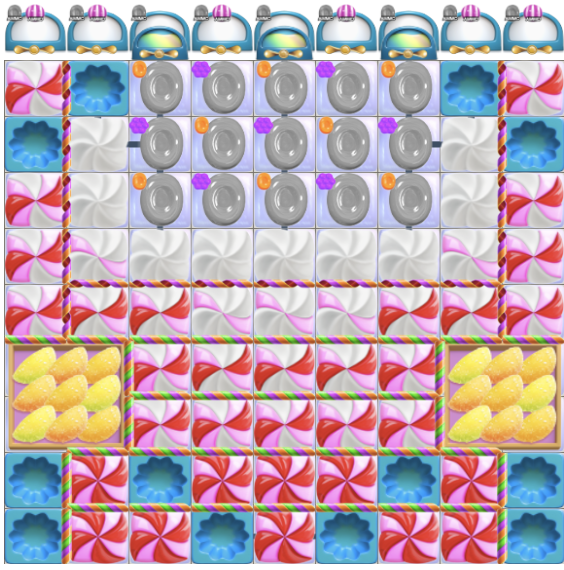
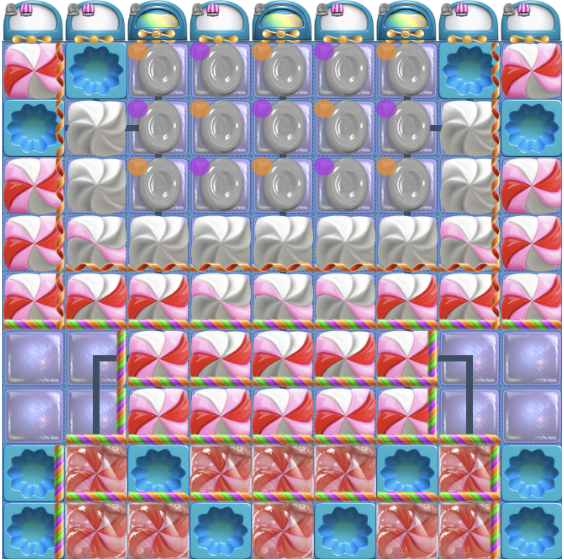
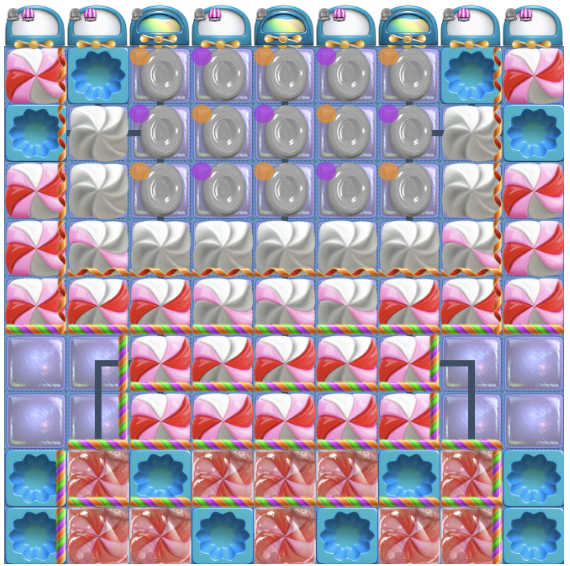
Inside Viper (the visual level editor), I designed a generative AI feature that produces level board layouts from designer-defined parameters. The interaction model centers on a simple principle: AI drafts, designers decide.

Designers configure constraints — sparsity (low/medium/high), symmetry axis, board dimensions — then generate candidate layouts. The system returns three options simultaneously, each with projected score thresholds (1-star, 2-star, 3-star). Designers can apply any layout directly to the canvas, modify it by hand, or regenerate with different parameters.

Why three simultaneous options, not one

Presenting a single AI-generated layout implies the system has found the answer. Presenting three signals that these are candidates — the system is offering material to react to, not a finished product. It shifts the designer's mental model from "accept or reject" to "which of these is closest to what I want, and how do I shape it from here?"

Why sparsity and symmetry as primary controls

Early in the process, I explored granular control over every parameter — element types, density per quadrant, specific blocker placement. But that defeated the purpose. Sparsity and symmetry axis are the two parameters that most affect how a layout feels at a glance, while leaving specific element placement to the AI. High-leverage, low-effort controls that match how designers actually think.

Score projections as a trust signal

Each generated layout shows projected 1-star, 2-star, and 3-star score thresholds. When projections match a designer's expectations, it builds confidence. When they feel off, it signals the layout needs manual refinement. Over time, this feedback loop helps designers develop an intuitive sense of when to trust the generator's output.

The blank-canvas problem

Designers creating standard production content often start from a known pattern and iterate. The Layout Generator formalizes that — instead of copying a previous level and modifying it, designers generate a structurally sound starting point and shape it. Faster, more variety, and avoids the subtle homogeneity that creeps in when every new level starts as a clone.

THE HARDER DESIGN CHALLENGE

Level designers are domain experts — they know intuitively what makes a level feel fun, fair, and surprising. AI could reliably produce layouts that hit mechanical targets, but “is this level actually enjoyable to play?” required human judgment. The question wasn't “how do we automate level design?” — it was “how do we give experts a useful starting point without undermining their creative authority?”

Sendback Feedback System

SHIPPED — ACTIVELY USED IN OUTSOURCED PRODUCTION

External studios produced a growing volume of levels but operated with far less context than in-house designers. When a level had issues, feedback was unstructured — reviewers left vague comments, outsourced designers didn't know what to prioritize, and levels bounced back and forth without clear resolution.

I designed a structured two-sided communication layer embedded directly in the Episode Planner.

01

For King reviewers

A modal that captures categorized feedback — reason category (APS off target, game-breaking issues, documentation, level variety), specific violation, and severity rating. Reviewers can log up to four distinct reasons per sendback, flag whether King already tweaked the level themselves, and add freeform comments. Submitting automatically transitions the level's status from "Ready" to "Tweak."

02

For outsourced designers

A read view that surfaces structured feedback clearly — each reason expanded with category, violation, and severity (color-coded: red for Very High, orange for High), plus the reviewer's comment. A threaded reply lets the outsourced designer respond directly, creating a conversation trail attached to the level.

FEEDBACK LOOP

King Reviewer

1

Submit structured feedback

Category, violation, severity

2

Auto status → "Tweak"

Pipeline stays in sync

Outsourced Designer

3

See structured feedback

Severity color-coded, categorized

4

Threaded reply → resolution

Conversation trail per level

KEY DESIGN DECISIONS

Structured categories

Over freeform-only feedback, so sendback reasons could be tracked and patterns identified at scale.

Severity ratings

Help outsourced designers triage when they have multiple levels in "Tweak" status.

Automatic status transitions

Keep the pipeline in sync — no manual status-tracking that causes levels to fall through cracks.

Discard confirmation

Safeguard to prevent accidental data loss mid-review.

The Ecosystem

These features didn't exist in isolation. The value was in how they connected across the production pipeline. The workflow moves left to right: plan → build → validate → review → test → release.

Episode Planner

Content scheduling & backlog management

Viper

Visual level editor with AI Layout Generator

Level Manager

Collections, A/B testing & release pipeline

Sendback Feedback

Structured review & cross-team communication

My contributions Existing platform

My contributions focused on reducing friction at the build, validate, and review stages — the points where designer time and cross-team communication were most often wasted.

Reflection

The three workstreams I owned looked like separate projects on paper, but they were all answers to the same question: how do you scale a craft-based production pipeline without losing the quality that craft produces?

The answer I kept arriving at was: make the knowledge explicit. Encoding quality standards in a feedback taxonomy so outsourced designers know exactly what “off target” means. Giving AI-generated layouts clear parameters so designers can evaluate them critically. The pattern is the same — you're taking knowledge that lived in experts' heads and making it available to systems and people who don't have that context yet.

SCOPE

I did not design the core Viper editor, Level Manager, or Episode Planner — these were designed by a previous UX designer. I contributed specific features, workflow improvements, and systems diagnosis within the existing platform.

Status: Layout Generator and Sendback Feedback system shipped. Screenshots generalized to respect proprietary information.

Restricted Access

Scaling Candy Crush’s Content Engine